FINANCIAL DISTRESS · ISSUE 052
Hospitals running out of cash: the days-cash signal, and why most of it is a reporting artifact
Federal HCRIS cost reports let us compute days cash on hand for 5,459 hospitals, but facility-level figures are distorted by system-level cash pooling — so the raw '2,800 hospitals under 30 days' headline is mostly noise. The defensible signal is narrower: 690 hospitals that report thin cash and also run an operating loss.
Across 5,459 US hospitals with usable cost-report balance sheets, the median reported days cash on hand is 27 days — against an audited-statement benchmark of 150 to 205. That gap is not a solvency crisis. It is mostly a reporting artifact: health systems pool cash at the parent and leave each facility's balance sheet nearly empty. The defensible distress signal is 690 hospitals that report thin cash and an operating loss.
What we measured, and what we found
Days cash on hand is the bluntest liquidity question you can ask a hospital: if every dollar of revenue stopped tomorrow, how many days could it keep the lights on from cash and liquid investments alone? It is the metric Kaufman Hall, the bond-rating agencies, and the recent wave of CalMatters and STAT reporting reach for when they describe hospitals "running out of cash." What none of that coverage has published is a named, facility-level, reproducible list built from primary federal data. We set out to build one — and the most important finding is about the data itself.
The CMS Healthcare Cost Report Information System (HCRIS), form CMS-2552-10, carries the balance-sheet and income-statement lines needed to compute days cash on hand for every Medicare-participating hospital. We derived it for all 5,459 hospitals whose cost reports contain a usable Worksheet G balance sheet and a positive cash-basis operating expense. The headline counts, before any quality screen:
- 2,380 hospitals compute to under 15 days of cash
- 2,800 hospitals compute to under 30 days
- 3,334 hospitals compute to under 60 days
- Median across all 5,459: 27 days
Taken at face value, that is a catastrophe — more than half the country's hospitals apparently a month from insolvency. Taken at face value, it is also wrong.

Why the naive number is mostly noise
A median of 27 days is roughly one-sixth of the figure that hospital finance offices, auditors, and rating agencies report from the same institutions. When a metric diverges from its established benchmark by that much, the metric is broken before the hospitals are.
The break is structural and well understood by anyone who has worked with HCRIS. The cost report's primary purpose is Medicare reimbursement, not financial disclosure. Worksheet G — the balance sheet — is one of the least reliable sections, because a facility's cash and investments are routinely held and reported at the parent health-system level, not at the individual hospital. A 600-bed flagship that anchors a multi-state system will often show only a nominal operating balance on its own Worksheet G, with the system's reserves invisible to the facility-level filing.
The fingerprints are unmistakable in the data. Of the 2,800 hospitals that compute to under 30 days of cash, 1,641 — fully 59% — report less than $100,000 in cash on hand. A genuine acute-care hospital with a $50-million expense base does not operate on $100,000. One large system hospital in our data reports a $6.6-billion annual operating expense and exactly $4,000 of cash — a balance sheet that is plainly kept on the parent's books, producing a spurious "0 days."
The proof that the formula is right and the data is the problem: the large systems that do complete their Worksheet G in full land exactly where audited statements say they should. Among the biggest hospitals by operating expense, fully-reporting facilities show 135, 156, 290, 326, and 405 days of cash — squarely inside the Kaufman Hall "strong" band. The arithmetic is sound. The balance sheets are uneven.
This is the same lesson the LEIE exclusion study reached from the other direction: a single public dataset, read alone, over-flags. The discipline is to screen the artifacts out before you publish a number, not after a reporter calls.The defensible signal: 690 hospitals
To separate genuine liquidity stress from a pooling artifact, we apply a composite screen — three conditions a distressed standalone hospital meets and a cash-pooling artifact does not:
- Credible cash reporting. The facility reports at least $100,000 in cash on hand — enough to indicate it keeps its own balance sheet rather than deferring to a parent.
- Thin liquidity. Days cash on hand below the threshold (15, 30, or 60 days).
- An operating loss. Operating margin is negative — the facility is burning cash, not merely holding little of it on the filing date.
A hospital that clears all three is not a reporting quirk. It reports its own cash, that cash is thin, and it is losing money on operations. Applying the screen:
- 454 hospitals report under 15 days of cash and an operating loss
- 690 hospitals report under 30 days and an operating loss
- 1,001 hospitals report under 60 days and an operating loss
Of 3,676 hospitals that report credible cash balances at all, 690 — about one in five — sit in the under-30-day-and-losing-money zone. That is the number that survives scrutiny, and it is roughly a quarter of the alarmist 2,800. It is also a floor, not a verdict: a facility can be genuinely distressed and still pool its cash, so the screen removes false positives at the cost of some false negatives.
Where the distress concentrates
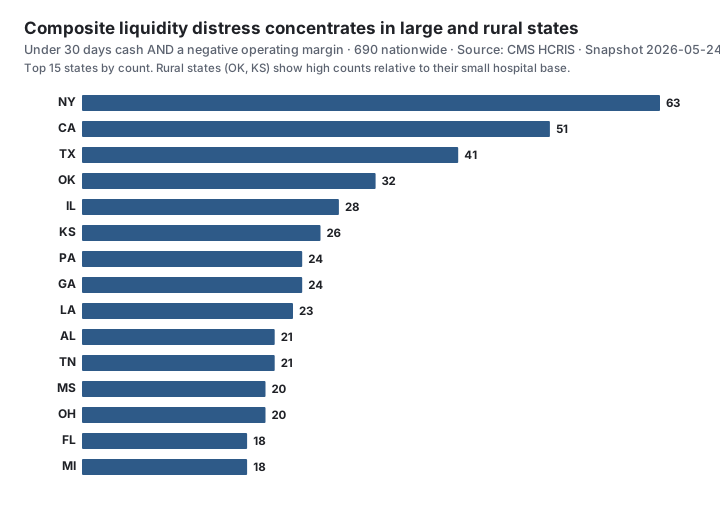
The 690 cluster in two predictable places. Large states carry large absolute counts — New York (63), California (51), and Texas (41) lead simply because they have the most hospitals. But the more telling pattern is rate: rural states such as Oklahoma (32), Kansas (26), and Louisiana (23) carry counts that are enormous relative to their small hospital bases. These are the Critical Access and rural referral hospitals at the center of the closure narrative — facilities with thin reserves, negative operating margins, and no parent system to pool against. The composite screen does not erase the rural-distress story; it sharpens it.
State here is derived from the CMS Certification Number itself — the first two digits of every CCN encode the CMS/SSA state code (33 = New York, 05 = California, 45 = Texas). No external lookup is involved, so the geography is as reproducible as the liquidity figure.
Methodology
Days cash on hand is computed from four cost-report lines, following the American Hospital Directory's published CMS-2552-10 worksheet reference — the same mapping the incumbent commercial indicators use:
Days Cash on Hand (All Sources) = (cash on hand + marketable securities + investments) ÷ ((total operating expense − depreciation) ÷ 365)
The component coordinates, confirmed against live cost-report payloads:
- Cash on hand — Worksheet G, line 1, column 1
- Marketable securities — Worksheet G, line 2, column 1
- Investments — Worksheet G, line 31, column 1
- Total operating expense — Worksheet G-3, line 4, column 1
- Depreciation — Worksheet A-7, Part III, line 3, column 9
Depreciation is removed from the denominator because it is a non-cash expense; days cash on hand measures cash outflow, not accrual expense. Operating margin, used for the composite screen, is the same HCRIS-derived figure published in our Hospital Margin Gap Analysis. The full query is in the reproducibility block below and in the HCRIS dataset page — every count resolves to a specific row in a specific frozen snapshot.
On timing. HCRIS carries a 12-to-18-month reporting lag. This snapshot reflects fiscal years ending mostly in 2023 and 2024. These figures describe a hospital's structural liquidity posture — its reserve discipline and operating-loss trajectory — not its bank balance this morning. A hospital can raise cash, draw a line of credit, or receive a system transfer the day after its cost report closes. Read the list as a standing-risk register, not a real-time monitor.
Why there is no named-facility table
The brief for this study called for a named list of the lowest-cash hospitals. We are not publishing one, for a reason worth stating plainly: there is no reliable way to attach hospital names to HCRIS CCNs inside our current data. The CMS Provider of Services file we hold does not cover the short-term-hospital CCN ranges HCRIS uses, and its facility-type labels are misaligned; the margin-gap index table carries no populated names or states. Rather than publish names sourced from a mismatched join — which is exactly the kind of plausible-but-wrong attribution that destroys trust — we publish CCN-keyed records with CCN-derived states and leave names to a future release once a clean CCN-to-name source is wired in. The downloadable dataset lets anyone perform that join against a public name list themselves.
How this differs from the Margin Gap study
This is a liquidity-axis study; our Hospital Margin Gap Analysis is a margin-axis study. Margin asks whether a hospital makes money on operations; days cash on hand asks whether it could survive a revenue interruption. The two diverge: a hospital can run a positive margin and still hold dangerously little cash, or post operating losses while sitting on a large endowment. The composite screen used here is precisely the intersection of the two axes — thin cash and an operating loss together — which neither study captures alone.
Limitations
- HCRIS reporting lag. Figures lag actual operations by 12–18 months and describe structural, not real-time, liquidity. This is the third place in this study we say so, because it is the most important caveat: nothing here predicts that any specific hospital will close.
- Balance-sheet pooling. Facility-level Worksheet G is unreliable for system-affiliated hospitals; our $100,000 cash floor screens the worst artifacts but cannot recover cash held on a parent's books. Some genuinely distressed facilities are therefore missed by the composite screen.
- No facility names. As above, records are CCN-keyed; we do not assert hospital names without a clean source.
- Threshold conventions. The 15/30/60-day cuts are analytic conventions, not regulatory definitions. Rating agencies and CMS use a range of liquidity bands.
- Self-reported, not audited. HCRIS is hospital-self-reported cost-report data. It is not an audited financial statement and Fonteum does not independently rate, rank, or pass judgment on any hospital's solvency.
Frequently asked questions
Does "under 30 days of cash" mean a hospital is about to close? No. It is a structural liquidity marker from a cost report that lags 12–18 months. Many hospitals operate for years with thin reported cash, supported by credit lines, philanthropy, or system transfers that the facility-level cost report does not capture.
Why is your median (27 days) so far below the 150–205-day benchmark? Because HCRIS facility-level balance sheets are inconsistently completed. System-affiliated hospitals pool cash and investments at the parent, leaving the facility filing with only nominal operating cash. The benchmark comes from audited, system-level statements; HCRIS is a facility-level reimbursement filing.
Why screen out hospitals with under $100,000 in cash? Because a real acute-care hospital does not run on that little. A near-zero cash line on a multi-million-dollar expense base is a sign the cash lives on a parent's books — a reporting artifact, not 60-day-to-closure distress.
What makes the 690 figure defensible? Each of the 690 reports credible cash, thin days-cash, and a negative operating margin. The first condition removes pooling artifacts; the third condition removes hospitals that simply hold little cash but operate profitably. What remains is genuine cash-and-profitability stress.
Where does the state come from if you don't have facility names? From the CCN itself. The first two digits of every CMS Certification Number encode the CMS/SSA state code, so geography is derivable without any external lookup.
Is this the same as the Hospital Margin Gap study? No. That study measures operating margin (do they make money?); this one measures liquidity (could they survive a revenue stop?). The composite screen here is the intersection of both.
Can I reproduce these numbers? Yes. The exact SQL is published in the reproducibility block and runs against the frozen HCRIS snapshot whose SHA-256 is recorded above. Every count resolves to specific rows in a specific frozen federal-data snapshot.
Sources
- CMS HCRIS Hospital Cost Reports (form CMS-2552-10) — the primary federal source.
- American Hospital Directory — Hospital Financial Indicators, 2552-10 worksheet reference — the days-cash-on-hand worksheet mapping used here.
- Kaufman Hall National Hospital Flash Report — the incumbent industry liquidity benchmark.
- CalMatters — California hospital financial distress coverage — the local-press narrative this study supplies a facility-level layer for.
Datasets used
Reproducibility
Every claim, reproducible
The SQL
-- Hospitals Low on Days Cash on Hand — fully reproducible query.
--
-- Source:   CMS HCRIS Hospital Cost Reports (form CMS-2552-10), FY2024 vintage.
-- Snapshot: cms-hcris-hospital-2552-10 / 2026-05-24
-- Archive:  https://downloads.cms.gov/FILES/HCRIS/HOSP10FY2024.ZIP
-- SHA-256:  e9552da36dcdcf904c5c4d35ffffe843af5b38afac196ac9db7db101bc8a96a0
--
-- Days Cash on Hand (All Sources) — per the American Hospital Directory's
-- published CMS-2552-10 worksheet reference:
--   (cash on hand + marketable securities + investments)
--     / ((total operating expense - depreciation) / 365)
WITH base AS (
  SELECT
    ccn,
    NULLIF(raw_payload->>'g000000_c1_l1','')::numeric                  AS cash,           -- Wksht G, line 1, col 1
    COALESCE(NULLIF(raw_payload->>'g000000_c1_l2','')::numeric, 0)
      + COALESCE(NULLIF(raw_payload->>'g000000_c1_l31','')::numeric, 0) AS investments,   -- G line 2 + line 31
    NULLIF(raw_payload->>'g300000_c1_l4','')::numeric                  AS total_oper_exp, -- Wksht G-3, line 4, col 1
    COALESCE(NULLIF(raw_payload->>'a700003_c9_l3','')::numeric, 0)     AS depreciation    -- Wksht A-7 Pt III, line 3, col 9
  FROM public.hcris_cost_reports_raw
),
dcoh AS (
  SELECT
    b.ccn,
    b.cash,
    365.0 * (b.cash + b.investments) / (b.total_oper_exp - b.depreciation) AS days_cash_on_hand,
    s.operating_margin_pct,
    left(b.ccn, 2) AS cms_state_code   -- first two CCN chars = CMS/SSA state code
  FROM base b
  JOIN public.hcris_facility_summary s ON s.ccn = b.ccn
  WHERE b.cash IS NOT NULL
    AND (b.total_oper_exp - b.depreciation) > 0
)
SELECT
  count(*)                                                                          AS computable,
  round(percentile_cont(0.5) WITHIN GROUP (ORDER BY days_cash_on_hand)::numeric, 1) AS median_days_cash,
  -- Naive, ARTIFACT-CONTAMINATED counts (do not headline these):
  count(*) FILTER (WHERE days_cash_on_hand < 30)                                    AS raw_under_30,
  count(*) FILTER (WHERE days_cash_on_hand < 30 AND cash < 100000)                  AS raw_under_30_near_zero_cash,
  -- Composite distress (defensible): credible cash AND operating loss AND low days:
  count(*) FILTER (WHERE cash >= 100000 AND operating_margin_pct < 0 AND days_cash_on_hand < 15) AS composite_under_15,
  count(*) FILTER (WHERE cash >= 100000 AND operating_margin_pct < 0 AND days_cash_on_hand < 30) AS composite_under_30,
  count(*) FILTER (WHERE cash >= 100000 AND operating_margin_pct < 0 AND days_cash_on_hand < 60) AS composite_under_60
FROM dcoh;
The snapshot
| dataset_id | cms-hcris-hospital-2552-10 |
| snapshot_date | 2026-05-24 |
| sha256 | e9552da36dcdcf904c5c4d35ffffe843af5b38afac196ac9db7db101bc8a96a0 |
| doi | 10.5072/fonteum/hospitals-low-days-cash-2026 |
| slsa_provenance_url |
The JOINs
cash               = hcris_cost_reports_raw.raw_payload->>'g000000_c1_l1'   -- Worksheet G, line 1, col 1
marketable_secs    = raw_payload->>'g000000_c1_l2'                          -- Worksheet G, line 2, col 1
investments        = raw_payload->>'g000000_c1_l31'                         -- Worksheet G, line 31, col 1
total_oper_exp     = raw_payload->>'g300000_c1_l4'                          -- Worksheet G-3, line 4, col 1
depreciation       = raw_payload->>'a700003_c9_l3'                          -- Worksheet A-7 Pt III, line 3, col 9
days_cash          = (cash + marketable_secs + investments) / ((total_oper_exp - depreciation) / 365)
composite_distress = cash >= 100000 AND days_cash < 30 AND hcris_facility_summary.operating_margin_pct < 0
state              = left(ccn, 2)  -- CMS/SSA state code; no reliable HCRIS-CCN to facility-name source exists in-platform
The pipeline version
| git_sha | 48d4a3b5 |
| slsa_provenance | |
| methodology_version | hcris-days-cash/v1 |
- FINANCIAL DISTRESS · MAY 2026Provider exclusions aren't rising — but they cluster around distressed operatorsNew additions to the OIG exclusion list are flat to declining — down 2.4% year-over-year through April 2026, and down 18.7% across full-year 2024 to 2025. The count is not the story. What concentrates is the composition: new exclusions cluster in facilities already showing the balance-sheet markers of financial distress.
- ACCESS · APR 2026A March spike in Medicare enrollment deactivations thinned provider supply in shortage areasMedicare enrollment deactivations in PECOS ran 28% above the trailing-twelve-month average in March 2026 — and the spike was not uniform. Deactivations in HRSA-designated shortage areas grew 41% against trend, versus 19% elsewhere. The places least able to absorb a departure lost providers fastest.
- CARE QUALITY · JUN 2026How fast do nursing homes fix what surveyors cite? 28.5 days for the harmful onesAcross 415,849 corrected CMS nursing home health deficiencies, the mean time from survey to documented correction is 32 days — but the harm-level citations, Severity G and above, close faster, in 28.5 days. The more severe the finding, the quicker the fix. Texas and Illinois correct in about two weeks; Washington, D.C. takes nine.
- CARE QUALITY · MAY 2026Why 14% of skilled nursing facilities had a quality drop in Q1Across 5,148 SNFs in Q1 2026, the composite quality score declined by an average of 0.06 points — but the decline was not evenly distributed. Facilities that changed ownership in the prior twelve months accounted for a disproportionate share of the slide.
- WORKFORCE · JUN 2026Zero-RN days: how often US nursing homes ran a day with no registered nurse on the floorIn the CMS Payroll-Based Journal's 2025 Q2 snapshot, 5.86% of nursing-home facility-days with residents present recorded zero registered-nurse direct-care hours — 77,542 days across 5,062 facilities. The rate ranged from 27.9% in Louisiana to 0.2% in Rhode Island. Days before the federal staffing floor was rescinded, this is the baseline the country now keeps.
Federal source citations
Fonteum Research · June 4, 2026 · All figures trace to the frozen federal-data snapshot cited above.